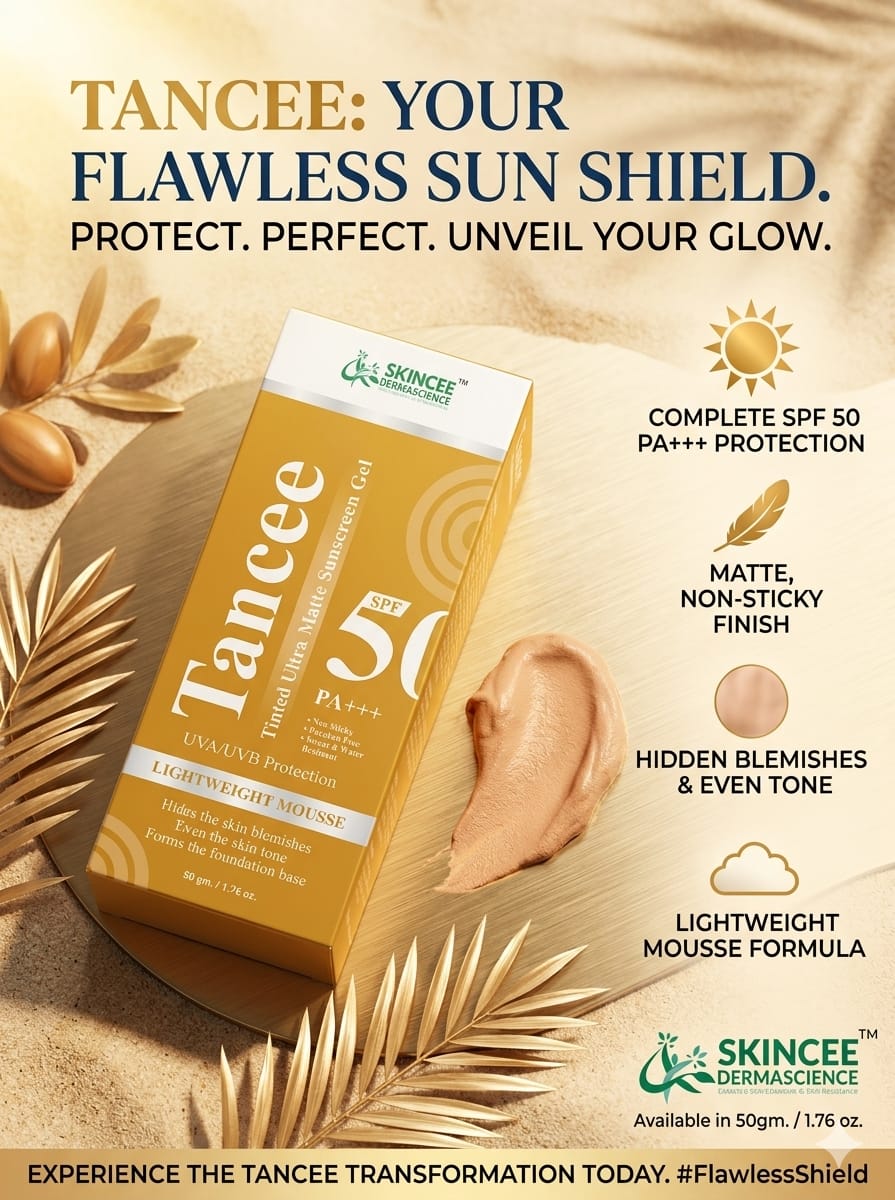
Sunscreen is the single most effective anti-ageing product available, and one of the most frequently misused. In India, where UV levels stay high through most of the year, daily sun protection is not a seasonal or beach-only concern. Yet most people apply far too little, too late in the day, and stop reapplying after the morning.
Decoding the label
SPF - protection from UVB
SPF (Sun Protection Factor) measures protection against UVB rays, the ones that cause sunburn and contribute to skin cancer. The relationship is not linear, which surprises most people:
- SPF 15 filters roughly 93% of UVB
- SPF 30 filters roughly 97%
- SPF 50 filters roughly 98%
So SPF 50 is not "three times better" than SPF 15. The practical advantage of a higher SPF is the buffer it gives you - since almost nobody applies the full laboratory-tested amount, a higher number helps compensate for real-world under-application.
PA+++ - protection from UVA
UVA rays penetrate deeper, drive photo-ageing and pigmentation, and pass through window glass. The PA rating measures this protection, from PA+ to PA++++. For daily use in Indian conditions, PA+++ or higher is a sensible target. A product labelled "broad spectrum" covers both UVA and UVB.
The practical shortlist: for everyday use in India, look for broad spectrum SPF 30-50 with PA+++ or PA++++. Anything beyond that offers diminishing returns compared with simply applying enough and reapplying.
How much is enough?
This is where most routines fail. Laboratory SPF ratings assume 2 mg of product per square centimetre of skin. In practice that works out to:
- Roughly a quarter teaspoon for the face alone
- Roughly half a teaspoon for face and neck together
- The two-finger rule - a line of product along the length of your index and middle fingers
Applying half this amount does not give you half the protection; it drops protection disproportionately. A generously applied SPF 30 outperforms a thinly applied SPF 50 every time.
Timing and reapplication
- Apply 15-20 minutes before going outdoors so the film can settle evenly
- Reapply every 2 hours of continued sun exposure
- Reapply immediately after swimming, heavy sweating or towel drying
- Do not skip cloudy days - a significant proportion of UV passes through cloud cover
- Apply indoors too if you sit near windows, since UVA penetrates glass
Choosing a texture that suits you
The best sunscreen is the one you will actually wear every day, so texture matters as much as the rating:
- Gel and lightweight fluids - suit oily, acne-prone and humid-climate skin. They spread easily, absorb fast and leave a non-greasy finish, making them comfortable for daily wear.
- Creams and lotions - better for dry or mature skin, where the extra emollient content is welcome.
- Tinted and matte formulations - help counter the white cast that mineral filters can leave on deeper skin tones, even out the complexion and can double as a light base under makeup.
Common mistakes worth avoiding
- Missing the ears, hairline, eyelids, lips, neck and back of the hands
- Relying on the SPF in a moisturiser or foundation, which is rarely applied thickly enough
- Assuming darker skin does not need protection - melanin helps, but does not prevent photo-ageing, pigmentation or skin cancer
- Using last year's bottle past its expiry, when filters may have degraded
- Treating sunscreen as a substitute for shade, hats and sunglasses rather than an addition to them
Sunscreen and pigmentation
If you are being treated for melasma, post-inflammatory hyperpigmentation or uneven tone, daily sun protection is not optional - it is the foundation the rest of the treatment rests on. UV exposure actively drives pigment production, and even an excellent brightening regimen will underperform without it. Tinted formulations offer an additional benefit here, as visible light also contributes to melasma.